Schee
Gate CrashersSchee is an Ish representative encountered during the Assembly’s examination of humanity. The character appears among a procession of nonhuman delegates whose bodies make the Assembly’s diversity physically unmistakable. Schee emerges from the surf onto black volcanic sand as one of the crab people, and communicates by clicking a claw. That restrained gesture becomes Schee’s recurring mark: a small, precise sound attached to an expansive judgment about the history and future of Earth.
Identity and Introduction
Schee is introduced by Bloon as “Schee, of the Ish,” placing the character within a species whose social and bodily difference is immediately legible to the human visitors. The introduction emphasizes not a humanlike face or voice but the movement of a claw and the unfamiliar setting of a shoreline made from black volcanic sand. Schee’s appearance therefore extends the Assembly’s larger presentation of alien life as radically varied rather than cosmetically human. The character is one delegate among many, but the claw-click gives Schee a distinct mode of presence and communication.
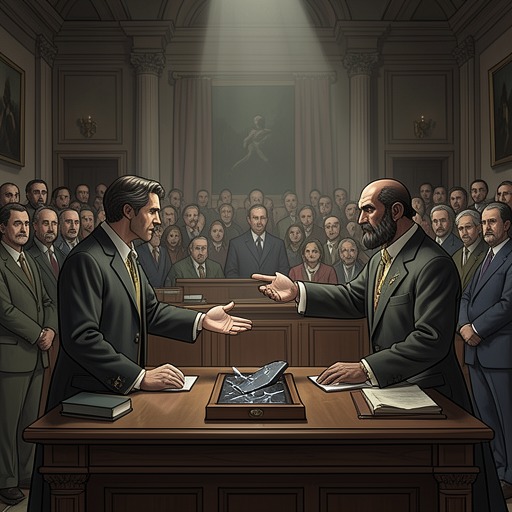
Schee’s physical introduction also establishes the Assembly as a contact zone in which humans are observed as carefully as they observe other species. Allison sits at the edge of the display areas while the delegates are presented one after another, and Schee’s entrance places the human visitors inside an arrangement controlled by nonhuman hosts. The scene reverses the usual hierarchy of exploration: Earth’s representatives are not simply discovering alien cultures but are themselves being classified, assessed, and interpreted.
Role in the Hearing
Schee’s most substantial contribution comes during the discussion of human history. Speaking for the Ish, Schee explains that Ish anthropologists have studied Earth for many centuries. Their observation had produced an expectation that global communication would reduce conflict and elevate human consciousness, because similar developments had done so for other species. Humanity instead divided into smaller, more extreme, and more ignorant groups. Schee thus presents technological connection not as an automatic path to unity but as an instrument that can intensify fragmentation.
This argument is sharpened by the surrounding account of the Great Nerd War, which began with a dispute between a Tolkien reenactment and a Star Wars live-action role-playing game after an insult concerning Christopher Lee’s performance as Count Dooku. Seventeen people died by the first evening, and eight years of fighting followed before the Shelter C Accords ended the conflict. Schee’s anthropological perspective converts an apparently absurd human anecdote into evidence in a larger indictment: Earth’s capacity for violence is not limited to disputes over territory, resources, or survival. Cultural taste and symbolic allegiance can also become grounds for lethal factionalism.
Schee does not merely list human crimes. The character describes the contradiction between humanity’s technological advancement and its persistent political regression. The Ish have watched Earth long enough to compare humanity’s development with the trajectories of other species, making Schee’s criticism historical rather than purely emotional. The charge is that communication infrastructure failed to produce the expected moral transformation, and that increased connectivity instead helped create more extreme and less informed divisions.
Judgment of Humanity
Schee’s intervention forms part of the Assembly’s case against Earth, but the character’s judgment is not presented as simple personal hatred. It is the conclusion of observers who have accumulated centuries of evidence. Schee’s perspective makes the hearing resemble an anthropological report as much as a trial: humanity is treated as a species whose behavior has been documented, compared, and measured against broader civilizational patterns.
The judgment is severe because the evidence includes both ordinary human conflict and planetary-scale violence. Elsewhere in the history under examination, the Lividite war against nearly every other power culminated in the destruction of worlds, while a high-space attack could bore a tunnel through a planet and trigger volcanic eruptions, tectonic devastation, and the collapse of its ecological order. Against that background, Schee’s account of humanity’s internal wars acquires a darker significance. The ridiculous and the apocalyptic belong to the same continuum: a species able to organize extraordinary technical achievements remains capable of directing intelligence toward extermination.
At the same time, Schee’s criticism leaves room for the fact that humanity has come as far as it has. The Fenax representative makes the more sweeping claim that two-thirds of human effort and resources have been spent fighting among themselves, and Allison immediately disputes the exaggeration. Schee’s position is more carefully grounded in observation. The character does not need to deny human achievement; the point is that achievement has coexisted with, and often been diverted by, recurrent violence. Humanity’s advancement is therefore neither proof of innocence nor proof of hopelessness.
Narrative Significance
Schee helps the novel hold two scales together. At one scale, the character is a memorable alien delegate defined by a claw-click, a place in the Assembly’s procession, and a nonhuman institutional voice. At another, Schee gives narrative authority to the civilization-wide question confronting Earth: whether technical progress has produced ethical progress. The character’s testimony makes human self-image answerable to an external record.
That external perspective also complicates the book’s treatment of catastrophe. Planetary destruction, retaliatory strikes, and weapons capable of delivering a 32.4-terawatt particle beam are described alongside bureaucratic delay, personal fear, malfunction, and dark humor. Schee belongs to the interpretive side of this pattern. Rather than causing a disaster directly, the character explains why the wider community regards humanity as dangerous. Schee’s evidence transforms the threatened attack on Earth from an arbitrary alien act into the consequence of a long argument about collective responsibility.
Schee ultimately functions as a witness for the Assembly and as a mirror for the human characters. Allison’s defensive response shows that the hearing is not only about facts but also about who has the right to define humanity. Schee’s claw-click, repeated as a compact sign of alien judgment, punctuates a scene in which Earth must confront the possibility that its history looks absurd, violent, and morally unfinished when viewed from outside.